
Your users increasingly work through AI assistants. When they ask an agent to check a case status, analyze last quarter's metrics, or kick off an approval workflow, that agent needs to access your enterprise systems. Enabling that connection is the core challenge of AI agent integration: giving AI assistants the ability to discover, understand, and safely interact with business applications and data on behalf of users.
The problem is, most enterprise applications weren't designed for AI-driven interaction and lack the granular security needed. Traditional REST APIs require the caller to know exactly which endpoint to invoke, what parameters to provide, and how to sequence requests. AI agents operate differently. They start with a natural language request and need to determine what tools are available, what inputs those tools require, and how to combine them to complete the task.
This is where traditional integration approaches start to fall short. Successful AI agent integration requires a standardized way for assistants to discover enterprise capabilities, understand how to use them, and invoke them reliably. That's where Model Context Protocol (MCP) comes in. MCP gives AI agents a standard way for AI applications to find and use approved enterprise tools without rebuilding custom integrations for every interaction.

The context layer: why the underlying platform matters
An AI agent can discover and invoke a tool through MCP. But a protocol alone doesn't make an integration valuable. What matters is what's on the other end of the connection.
When an external AI agent connects to Appian through MCP, it doesn't reach a collection of disconnected endpoints. It reaches a unified platform where data, process logic, security, and AI governance are already woven together. That foundation, what we call the context layer, is what transforms a protocol connection into something an enterprise can actually rely on.
Consider what's already in place before an agent ever makes its first call:
Data fabric. Records, relationships, and views that reflect how your business actually works. Without this, an agent is querying raw tables with no understanding of what your terminology (such as "customer" or "case") means in your organization.
Process logic. Business rules, workflows, and orchestration that define how work gets done across systems, people, and AI. Without it, an agent is limited to isolated API calls with no understanding of approvals, routing, SLAs, or downstream dependencies. That operational logic already exists in Appian, and MCP lets the agent invoke it without re-implementing it.
Security model. Object-level permissions, record-level security, and group membership that determine who can see and do what. The agent inherits these automatically, without the need to build a separate authorization layer.
AI governance. Guardrails, usage tracking, and model controls that ensure every AI interaction meets your compliance requirements, regardless of which external tool initiated it.
An AI agent invoking an Appian process model through MCP inherits all of this automatically. It doesn't need to re-implement your security rules, re-encode your business logic, or build its own audit trail. Appian’s context layer handles it.
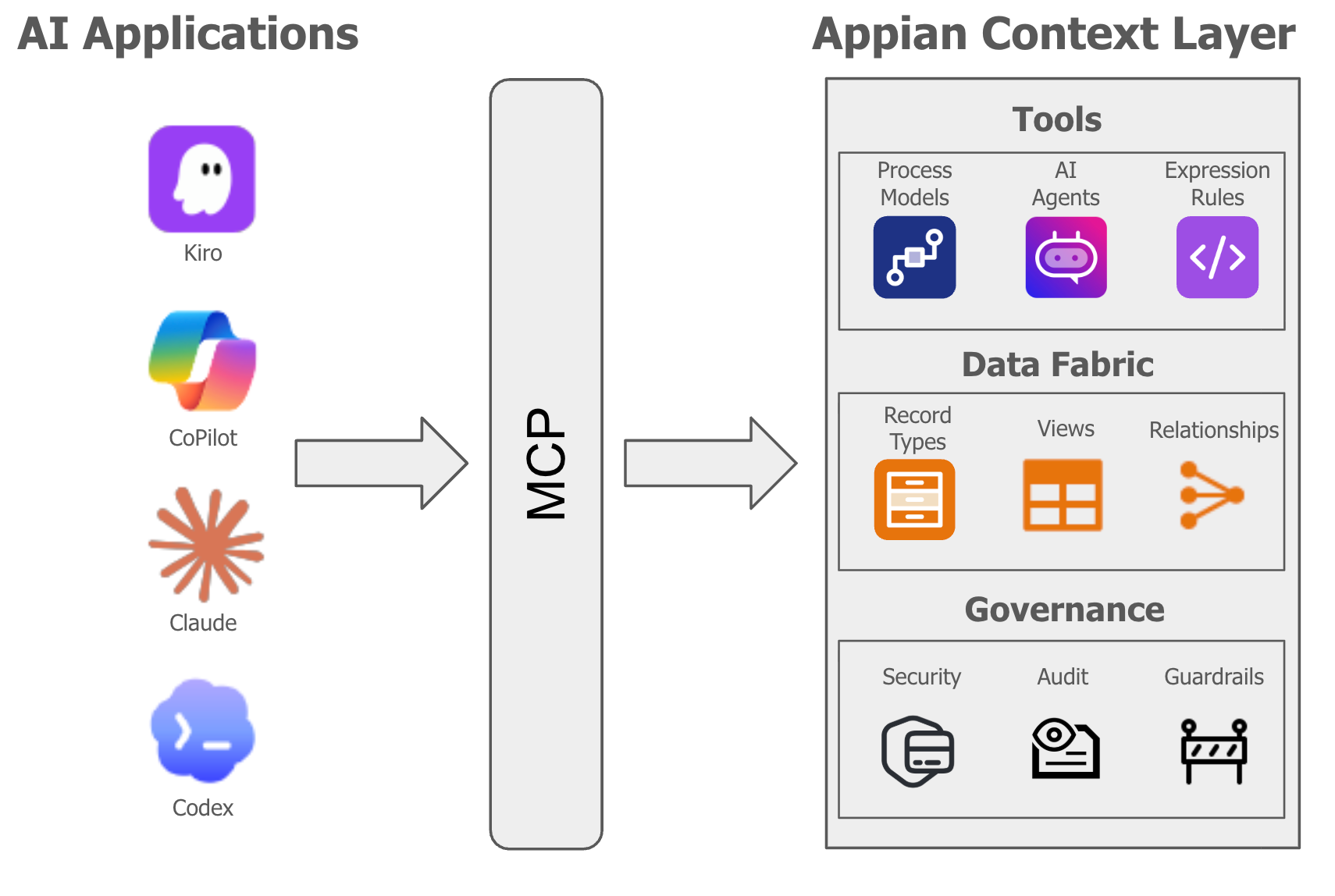 External AI applications connect and leverage Appian's unified context layer through a secure MCP bridge.
How it works: discover, understand, execute
Rather than exposing hundreds of individual endpoints, Appian provides a small set of generic tools that let AI agents discover and invoke capabilities dynamically:
Discover. The agent searches for available tools by intent. A natural language query like "Find me something that creates cases" returns matching process models, expression rules, or AI agents that the user has permission to access.
Understand. The agent retrieves the full input/output schema (parameter names, type, description, and requiredness) for the tool it wants to call.
Execute. The agent invokes the tool with the correct parameters and receives structured results.
Security inherited from the platform
Enterprise adoption of any integration protocol comes down to trust. Appian’s MCP implementation enforces the same security model as the platform itself:
Tool discovery is permission-aware. AI agents operate with the same permissions as the user who invoked them. For example, a basic user won’t see an admin-level tool like password reset or user deactivation, because tool visibility is governed by the same Appian permissions that control access across the platform.
Tool execution respects object security, record-level security, and group membership.
AI guardrails evaluate inputs and outputs for risks like prompt injection and PII leakage.
Every invocation flows through the existing audit trail.
This isn’t a new security surface. It’s the existing security surface, made accessible through a new protocol. A user who can’t see a record in Appian can’t query it through MCP, either.
Example: creating a case
An external compliance system detects a potential data handling violation and needs to open a case in Appian. The system's AI agent, authenticated as a service account with an API key, processes the event and initiates case creation through MCP as follows:
- Searches for tools matching "create case" and finds a process model called Initiate Case
- Retrieves the schema and learns it needs a case type, description, region, and priority, with optional fields for assignee and due date
- Invokes the process model with structured inputs mapped from the event data
A case record is created in Appian and assigned to the right team based on region and case type. From there, the existing process takes over. Escalation rules fire, notifications go out, and the case moves through your workflow exactly as designed. The MCP call didn't just write a record, it triggered governed orchestration. The result is faster case intake, fewer manual handoffs, and no custom point-to-point integration.
On repeat invocations in the same session, the system already knows the tool and its schema. Subsequent calls drop to a single step.
Governed AI agent integration at enterprise scale
If your users already work in AI tools, access to enterprise data is inevitable. The question is whether it flows through governed, auditable channels or through workarounds you can't control. With Appian:
No rebuilding required. Existing process models, expression rules, AI agents, and record types become MCP tools with a configuration toggle. External agents invoke the logic you've already built.
Governance stays centralized. Administrators control which capabilities are available, developers decide which objects to enable, and existing permissions determine who can access them.
Your users stay productive. Users don't need to leave their AI tool to access Appian data or trigger Appian workflows. The platform meets them where they already work.
Enable the Appian MCP Server in your Admin Console—and your existing process models, rules, and agents become available to any MCP-compatible AI tool, governed by the same security your organization already depends on.
Learn more about building your agentic workforce in Appian.
