
Appian’s latest updates deliver powerful new tools to consolidate legacy systems, automate complex knowledge work, and scale data integration.
Keep reading for a breakdown of what's new or watch the webinar for a more detailed look.
Accelerate modernization with Composer
Modernization projects are notoriously high risk, but Composer derisks the start of your journey by ensuring total stakeholder alignment before development begins.
Composer uses AI to transform raw legacy requirements—now including multi-file uploads like Excel and business requirement documents (BRDs)—into a collaborative, visual application plan. Once stakeholders are aligned, developres can generate foundational objects like records, process models, and initial interfaces with AI.
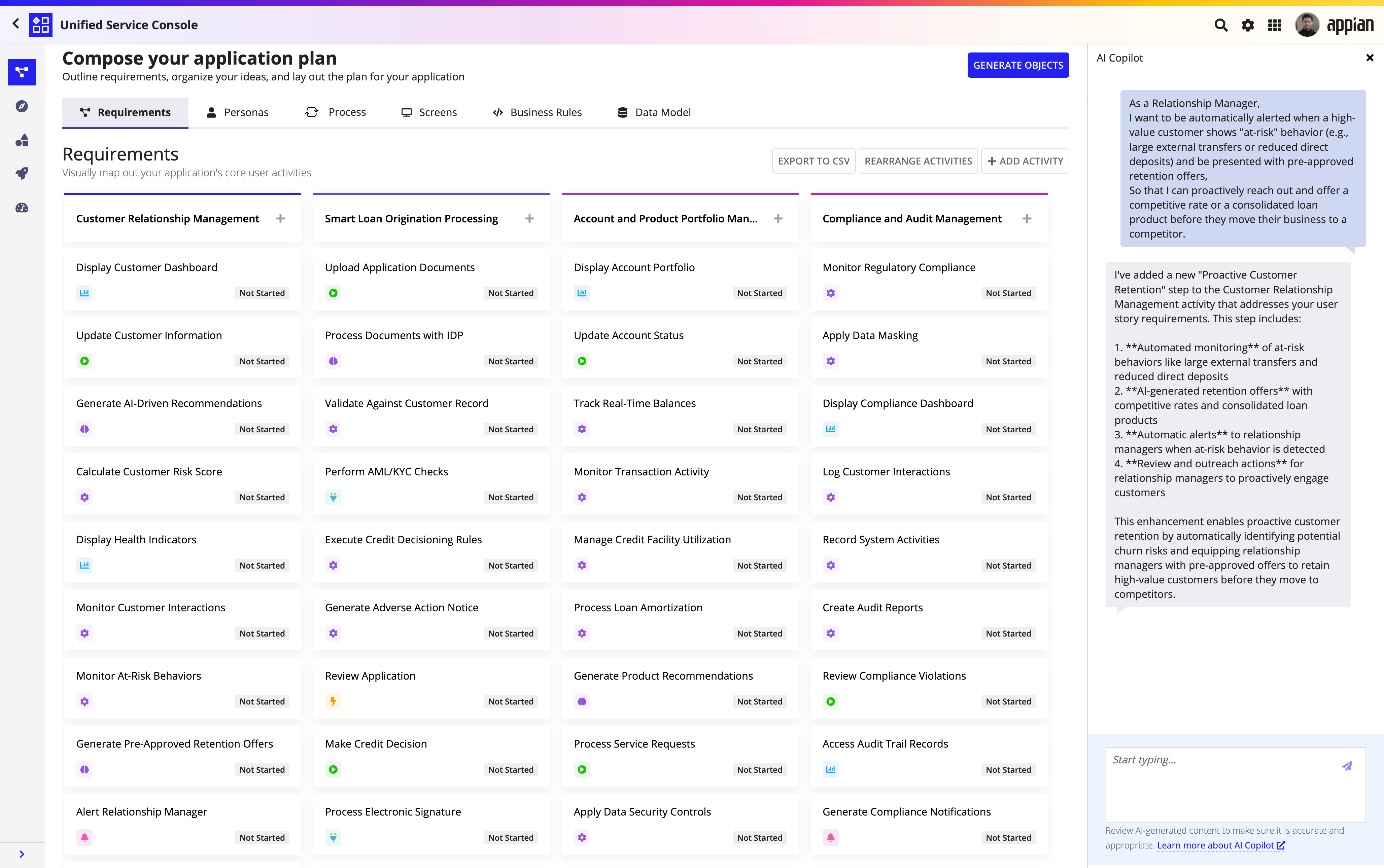
Composer generates complete application plans from files like requirements documents and notes.
New Composer capabilities
- Multi-file requirements upload. You can now upload multiple files simultaneously, including Excel spreadsheets and business requirements documents (BRDs), giving the AI better initial context to build your application plan.
- Enhanced performance and scalability. Managing plans remains fast and responsive, even when scaling from dozens to hundreds of user stories.
- Direct AI editing. The improved AI assistant is now available directly on the Process and Data Model tabs, allowing you to instruct AI to modify application diagrams based on new business requirements.
- CSV export capability. You can export your generated requirements directly to a CSV file, making it easy to import them into project tracking tools like Jira.
What the updates mean for you
Composer dramatically reduces time-to-market and prevents expensive development errors caused by miscommunications. In early real-world results, a global reinsurance company reduced their Sprint 0 planning phase from 80 hours to just 5 hours.
Developers no longer have to start from scratch. Composer acts as a bridge, turning massive amounts of technical complexity into visual elements. The AI assistant can even directly update process diagrams and data models based on real-time feedback during alignment meetings.
Automate complex work with AI
Appian is pushing beyond standard chat-based AI by integrating autonomous AI agents directly into your business processes. Agent Studio now supports multi-agent communication, where agents can invoke other agents as tools to complete tasks. And you can now allow third-party agents to securely access metadata from your data fabric—enhancing the effectiveness of your entire agent ecosystem.
Additionally, DocCenter has been enhanced with new capabilities for higher extraction accuracy, document rotation, and automatic document splitting for bundled packets.

Configure agents with simple goals and instructions in Agent Studio.
New AI capabilities
- Agents as tools. AI agents can now directly invoke and communicate with other agents to complete tasks, removing the need for workarounds that required a process to act as the intermediary.
- Empower third party agents with extensible metadata. Third-party agents can use Appian’s secure data fabric to obtain the context and information needed to be more successful in their work, enhancing the effectiveness of your entire agent ecosystem.
- Automated document splitting. Automatically split bundled document packets (such as separating a W-2 from a 1040 tax form) directly within DocCenter, eliminating the need to build a custom process first.
- Streamlined agent development. Accelerate your AI agent development with a single, split-pane view for configuration and testing that provides a faster, more intuitive development experience.
What the updates mean for you
While traditional process automation handles 80% of predictable workflows, AI agents are designed to handle unpredictable edge cases that typically require human intervention. Appian agents eliminate slow, inconsistent decision-making and free up your experts for higher-value work. For example, Acclaim Autism used Appian agents to automate complex clinical scheduling, achieving 98% faster patient intake.
Developers can configure agents with simple goals and instructions—now viewable in Markdown format—and grant them secure, role-based access to the data fabric or tools like DocCenter. Developers also get full transparency to audit the exact steps an agent took to accomplish its goals.
Strengthen your data strategy with expanded data fabric
A robust data strategy is essential for effective AI, and Appian has dramatically expanded the types of data you can incorporate into your data fabric.
You can now connect to external document stores and sync their metadata alongside your business data. And we’ve introduced zero-copy connections for unsynced data sources (currently for MariaDB and MySQL), support for database views, and support for composite keys. We also support no row limit for data syncing, previously capped at 50 million.

Connect and sync metadata from external document systems in your data fabric.
New data fabric capabilities
External document store integration. Connect your external document systems to Appian, syncing their metadata directly into your data fabric alongside the rest of your business data.
Zero-copy connections. A new type of record allows you to access unsynced data via a zero-copy connection, currently supported for MariaDB and MySQL.
Seamless sync toggling. Effortlessly switch your data sources between synced and unsynced modes as your performance needs or security requirements change.
Database views and composite keys. Connect to read-only database views (as synced or unsynced sources) and support read-and-write on RDBMS-backed record types using composite keys.
- Removal of sync row limits. The previous hard cap of 50 million rows for data syncing has been removed, letting you sync as much data as your specific license tier permits.
What the updates mean for you
By removing previous data syncing row limits and natively supporting these advanced data architectures, businesses can unlock new operational use cases and act on real-time data without undertaking costly database migrations.
Developers can now seamlessly toggle data sources between synced and unsynced modes based on evolving performance and security needs. They can also easily incorporate complex legacy data structures, such as database views and composite keys, without relying on expensive ETL pipelines. This flexibility allows organizations to keep their systems of record fully intact while establishing a unified, secure knowledge layer accessible to both Appian and third-party AI agents, like those from Salesforce or SAP.
Increase enterprise flexibility with UI and DevOps enhancements
Large enterprises require a careful balance between rapid application development and strict organizational control. To meet the strict AI compliance and branding requirements, Appian is introducing enhanced declarative controls and greater platform, provider, and model choice.

Configure granular styling elements directly from the admin console.
New UI and DevOps capabilities
- CSS profiles. Configure granular styling elements—like input border thickness or specific error colors—inside the admin console to adhere to strict corporate style guides, without creating code management issues.
- Release management (coming in April). Larger development teams will be able to bundle multiple deployment packages into a single release to easily push coordinated changes through the SDLC pipeline.
What the updates mean for you
Highly regulated businesses can build custom, scalable applications without sacrificing speed or violating their unique architectural and compliance demands.
For user experience, development teams can now adhere to strict corporate style guides without creating the code management and design governance headaches typically associated with unfettered, custom CSS.
For DevOps, large teams with multiple development pods can easily separate their coding concerns while seamlessly coupling their diverse packages into a single, coordinated release for testing and production.
Learn more about what's new
- Read the 26.3 release notes to explore all the latest updates to the Appian Platform.
- Watch the webinar for a closer look at release highlights.

