
-
Platform
-
Solutions
-
Customers
-
-
Resources
-
Company







Next time, try CTRL + K to open the search
Engineering teams have already solved the speed of code generation. With AI coding tools increasing in scale and effectiveness, writing syntax is no longer the bottleneck in software delivery.
But the bottleneck still exists when you get ready to deploy your code. In critical operations, such as commercial lending, payment investigations, or insurance claims intake, AI coding velocity can look impressive while actual deployments stall. Generating code without the right planning and oversight floods repositories with unvetted dependencies, untested edge cases, and compliance issues. Teams write code quickly during the initial build, only to spend months wading through architectural debt and security reviews before their software can even be deployed.
Software fails when requirements are misunderstood, policies are omitted, and software supply chains are left to chance.

The role of agile in AI-assisted development
Agile practices were created to handle shifting requirements through iterative collaboration, clear acceptance criteria, and continuous verification. AI coding needs structured requirements in order to create solutions that meet business needs.
Spec-driven development brings Agile discipline to AI-assisted development. Instead of prompting against a blank editor, teams model functional requirements, data relationships, and compliance rules into structured, machine-readable specifications before generating any application components.
These specifications act as a contract between product owners, system architects, and AI coding tools. User stories maintain acceptance criteria, and changes can be assessed against business objectives. Development can now move quickly without losing alignment.
However, spec-driven development is a method, not a complete enterprise strategy. Tools like Kiro, Cursor, and Claude Code already use specifications to plan and generate code at unprecedented speed. The architectural question becomes what libraries and frameworks will the solution use, and where generated code gets deployed.
The need for a managed platform
Building custom applications with standalone AI tools forces IT to own every layer of the application, which creates multiple risks:
Supply-chain exposure: Auditing third-party dependencies for compromised or hallucinated libraries.
Maintenance overhead: Tracking library deprecation, updates, and framework migrations across codebases.
Compliance accreditations: Maintaining access controls, encryption, and audit trails required for security and compliance frameworks like SOC 2, HIPAA, and FedRAMP.
When engineering teams own their solution down to the studs, every AI-generated application compounds the long-term maintenance burden.
A managed platform shifts this ownership model. By separating business logic from underlying platform infrastructure, a managed platform absorbs many facets of maintenance, security patching, and compliance accreditations below the line. Applications are built from pre-tested, declarative components rather than custom libraries. When security vulnerabilities emerge or browser standards evolve, the managed platform adjusts across the entire application portfolio, freeing engineering teams from costly maintenance overhead.
Connecting specifications to a managed runtime
Putting this architecture into practice requires a delivery model where specifications remain connected to the application. Appian connects business plans to applications through three stages:
Extract. The platform ingests documentation, policy rules, and process maps, turning them into a structured requirements plan.
Collaborate. Business analysts and IT developers review and refine user stories, data models, and workflows through a collaborative, visual experience before implementation begins.
Implement. Teams assign user stories to developers or agents, who use declarative Appian objects to build scalable solutions that match the specification.
Composer, Appian's AI-assisted development environment, acts as a context store throughout this process. By using Appian’s declarative design objects, the platform manages maintenance and security burdens below the line. Platform hotfixes apply security patches, browser compatibility updates, and performance optimizations across applications without requiring teams to rewrite anything.
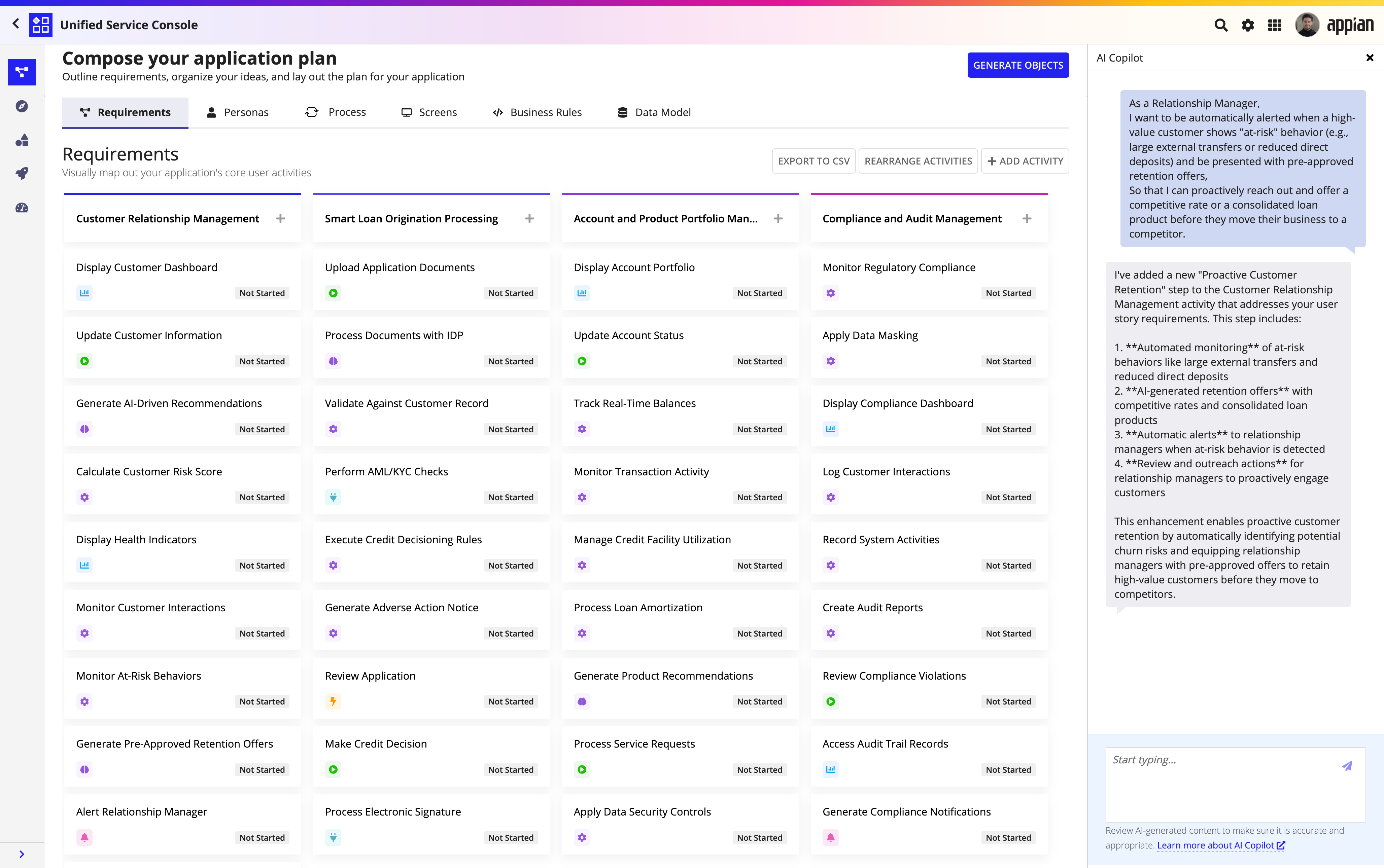
This approach pairs well with AI coding tools through Model Context Protocol (MCP). Developers can connect their preferred AI coding tools like Claude Code, Codex, or Kiro directly to their Appian environment. Engineers keep their preferred tools while ensuring the solution they build is deployed as governed, declarative objects within a managed runtime.
A managed platform does not eliminate code review. People still inspect what gets built, but reviewing visual models and structured workflows takes less time than auditing thousands of lines of custom code—giving IT teams a sustainable way to scale AI development in mission-critical environments.
The sweet spot: AI speed with enterprise trust
See how Appian Composer connects spec-driven planning, developer agents, and managed runtimes across the application development lifecycle.
