
-
Platform
-
Solutions
-
Customers
-
-
Resources
-
Company









Next time, try CTRL + K to open the search
Great customer experience happens behind the screen: in intake, handoffs, and case handling.
- A faster portal doesn’t help customer wait times if the work behind it is disconnected.
- AI belongs inside specific process steps, guided by clear rules and human decisions on exceptions.
- Start with one real journey, and measure progress before and after go-live.
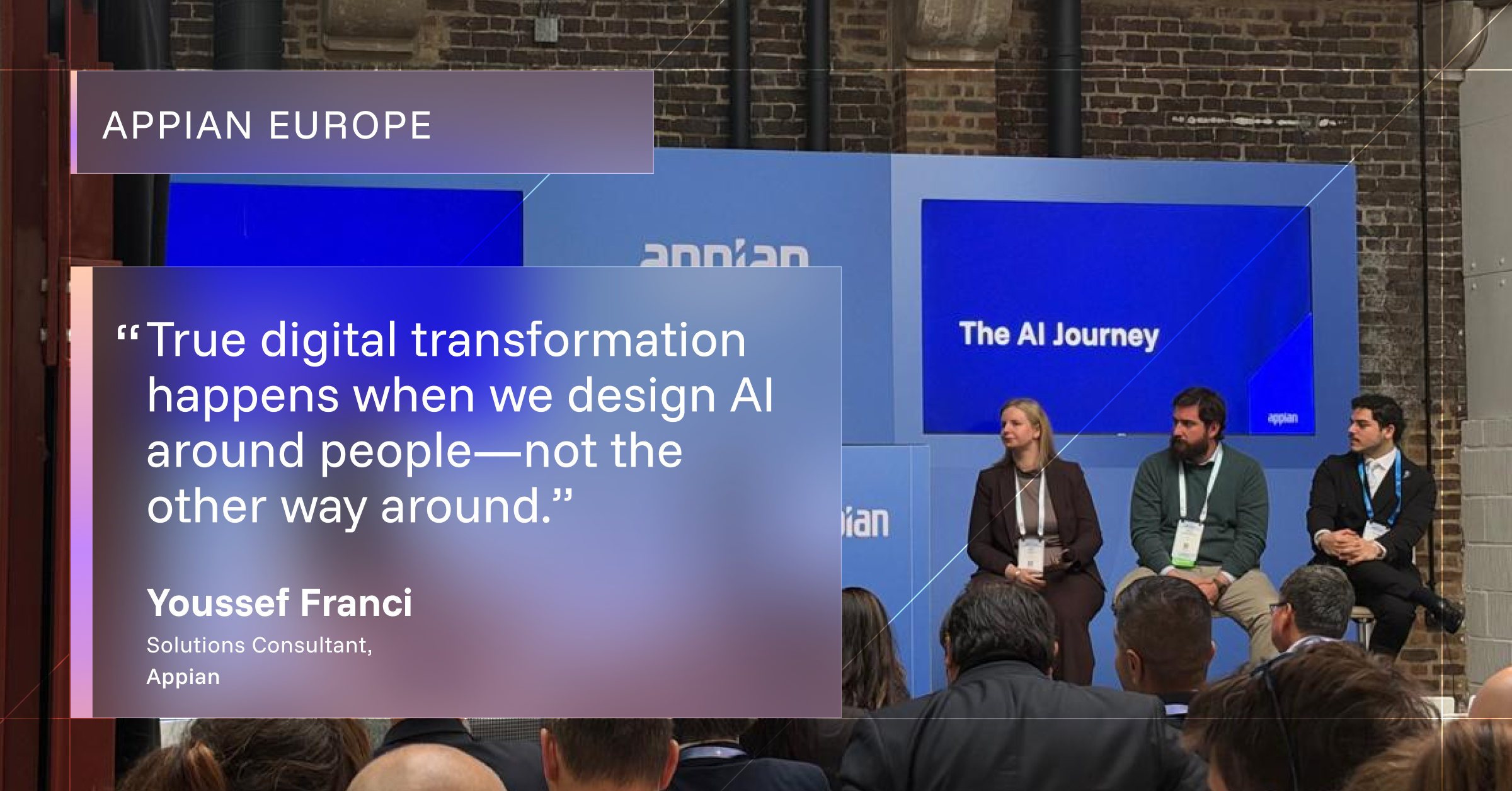
Most companies spend heavily on glossy portals, mobile apps, and flashy AI assistants. Yet when a customer needs an answer, everything stalls the moment a request hits the back office. At Appian Europe, Appian and PwC shared two real-world turnarounds that show how to fix this broken handoff.
Why does customer experience stall after submit?
Customer experience breaks at handoffs, not on the screen. People judge a service by how fast it works and whether it gets things right the first time. Both depend entirely on back-office operations.
Requests pour in through email, portals, and scanned paper, with no central queue. Staff still manually match, verify, and route each piece. A shiny front end just shifts the start line without making the work faster. As PwC pointed out in the session, the screen is only where someone uses a service. The actual service is the underlying journey: roles, rules, data, connections, and workflow.
What does a connected experience actually look like?
It means one shared record per request, no matter where it came from. Two examples from PwC illustrate the shift.
Settling an estate. When a family notifies a bank that a loved one has passed away, paperwork arrives across different channels at different times. Usually, staff piece the case together manually while the grieving family wonders what is happening. PwC built a single hub for estate handling with clear roles, shared documents, and live status tracking. Caseworkers get a clean, organized file and clear next steps instead of a messy inbox.
A single front office. Employees at a large European insurer used to jump between more than 20 systems to help one customer. Now, they work from a single dashboard connecting over 30 services, with Appian guiding each step. The real-world results: a complete customer view in under two seconds, 40% less time to prep sales deals, and 22% more customer interactions started.
In both cases, each request enters once, stays on one track, and keeps ownership clear whenever work shifts hands.
Where should AI live in your workflow?
Put AI directly inside specific process steps, not off to the side. Let automation handle standard steps. Use AI agents for heavy lifting like pulling data, checking details, and spotting missing files. Let humans handle exceptions.
Set clear business rules so the AI stays within bounds. When data is missing, the system routes the case to a team member with a plain note explaining what is needed. Because AI operates within the workflow, every step leaves an audit-ready log showing who did what, when, and who approved it.
Instead of asking where to add AI, ask which specific bottleneck or repeat task you want to fix. Start with the customer journey, then pick the right tool: clearer guidance, better system connections, process automation, or AI.
How should you measure real impact?
Start measuring before launch, and choose metrics that match the actual journey. During the front-office revamp, PwC gathered employee focus groups early on. Their direct feedback reshaped screen layouts and daily workflows, making adoption seamless at launch.
Speed alone can be deceiving. When settling an estate, total time varies widely because families collect documents at their own pace. Smarter signals include contact frequency, repeated document requests, and whether customers know what happens next. The biggest pain point for a customer is uncertainty, and that rarely shows up on a standard dashboard.
Where should you begin?
Pick one process with obvious friction, frequent document passing, and an engaged business owner. Map the path from submission to resolution, spot where work stalls or repeats, and set clear baseline goals before selecting technology.
The goal is not just fewer tools or extra automation. It is simpler work for employees and a smoother, reliable experience for customers.
